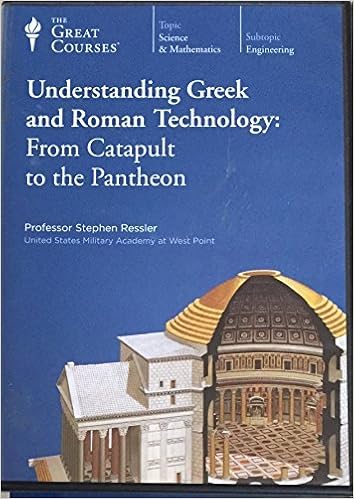
The Great Courses - Understanding Greek and Roman Technology: From Catapult to the Pantheon - Stephen Ressler, Ph.D.
Shared by:ihophats
Written by ,
Read by Stephen Ressler, Ph.D.
Format: MP3
Bitrate: 80 Kbps
Length: 12 hrs and 25 mins
Famed for great thinkers, poets, artists, and leaders, ancient Greece and Rome were also home to some of the most creative engineers who ever lived. Many of their feats have survived; others have disappeared into the mists of time. But modern research is shedding new light on these renowned wonders—impressive buildings, infrastructure systems, and machines that were profoundly important in their own day and have had a lasting impact on the development of civilization.
Hide Full Description
The glories of ancient Greek and Roman engineering include these iconic buildings:
The Greek Parthenon: Arguably the most aesthetically pleasing structure ever built, the Parthenon achieves this effect through astonishing precision in its architectural plan and stone masonry construction.
The Roman Colosseum: This ingeniously designed, mammoth arena represents a grand compromise between traditional stone masonry and a revolutionary construction method incorporating brick and concrete.
The Roman Pantheon: The ancient world’s most ambitious engineering achievement, the Pantheon is known for its cast concrete dome that has never been equaled in beauty or construction ingenuity.
Also on the list of impressive achievements are ancient technologies that you use every day:
Roads: Networks of well-drained, hard-surfaced roads are a legacy of the Romans, who even installed curbs, wide shoulders, and periodic steps to aid travelers in mounting horses or carriages.
Water systems: Large-scale systems for supplying clean water and drains for carrying away wastewater were also developed by the Romans, whose aqueducts and sewers transformed urban life.
Pumps: The Greeks and Romans invented a variety of techniques to move water. One, Archimedes’ screw, remains in widespread use today in devices from combine harvesters to snowblowers.
These and many other developments grew out of the same conditions that produced new political institutions, stunning sculptures, outstanding literary works, and empires that constituted much of the known world. In such a climate, is it any wonder that technology also flourished? Yet the engineering exploits of the Greeks and Romans are not as celebrated as they deserve to be, and they have been long discounted by some historians. However, new discoveries combined with a reevaluation of evidence show just how clever our ancient ancestors were.
In 24 lavishly illustrated lectures, Understanding Greek and Roman Technology: From Catapult to the Pantheon gives you an in-depth appreciation for what the Greeks and Romans achieved and how they did it. Your guide is Dr. Stephen Ressler, a former professor at the United States Military Academy at West Point, a civil engineer, and a nationally honored leader in engineering education.
A Golden Age of Engineering
Understanding Greek and Roman Technology is a fascinating introduction to basic engineering principles and the science behind them. The course also gives a new perspective on one of the most productive periods in the history of civilization: classical antiquity. In case after case, you will find that engineering solutions reached during this era would not be surpassed for another thousand years or more.
These lectures are also ideal preparation for anyone planning to visit Greek or Roman sites. Even ancient building rubble is captivating if you know what to look for: tool marks, holes for joining pegs, projections used for lifting, and other signs that tell the purpose of a particular block of stone. Professor Ressler describes a field trip to an archaeological site in Turkey, where one of his students noticed chiseled Greek letters on foundation stones—markers that were clearly used to place the stones in their correct positions.
Clue by clue, Professor Ressler assembles a detailed picture of how ancient engineers went about their work. First you learn about the building materials available in antiquity and their strengths and weakness under different loads. Then you proceed to the three major sections of the course, which cover structures, infrastructure, and machines. Here is a taste of what you will learn:
Concrete: The versatility of form and composition of concrete made possible enormous structures and efficient new architectural forms in Rome’s awe-inspiring building program. Professor Ressler demonstrates the role of concrete in a sturdy Roman wall.
Cranes: Trajan’s Column in Rome consists of marble drums weighing as much as 60 tons each. How were they lifted into place? Professor Ressler shows how cranes powered only by human muscles were up to the job.
Catapults: Engineers improved catapults over a period of 700 years, developing new ways to store energy and propel a heavy projectile to its target. Innovations associated with this weapon include the universal joint, now used in automobiles.
Triremes: Professor Ressler’s favorite piece of ancient technology is the trireme, the racehorse of Greek warships, with three banks of oars and a bronze ram. Details of its design and construction were long uncertain—until 20th-century enthusiasts decided to build one.
Lead pipes: One of the many theories explaining the fall of Rome blames chronic lead poisoning from lead pipes used in water systems. But Professor Ressler explains why this idea does not “hold water.”
Slaves: A widespread theory contends that the Greeks and Romans had no incentive to develop labor-saving machines because of their access to slaves. But Professor Ressler proves that many ancient projects would not have been possible without unprecedented technology.
Get inside the Classical Mind
An engineer in the mold of his versatile predecessors in antiquity, Professor Ressler not only created all of the physical models used in this course but most of the computer models as well. Unlike off-the-shelf graphics, these animations are tailor-made to answer specific questions in the lectures, deepening your understanding of how ancient engineers worked and giving you a realistic picture of ancient problem solving in action.
Understanding Greek and Roman Technology opens with a thought-provoking lesson. In 480 B.C., Greek naval forces decisively defeated the invading Persian armada at the Battle of Salamis, thanks to the Greeks’ superior deployment of technology. The Greeks maximized the performance of their trireme warships to overcome a Persian advantage of 3 to 1. Had they not achieved this crucial edge, they surely would have lost, halting the growth of classical civilization before it could spread. What better demonstration of the influence of technology on the course of human events!

| Announce URL: | |
| This Torrent also has several backup trackers | |
| Tracker: | udp://tracker.open-internet.nl:6969/announce |
| Tracker: | udp://tracker.opentrackr.org:1337/announce |
| Tracker: | udp://tracker.tiny-vps.com:6969/announce |
| Tracker: | udp://tracker.vanitycore.co:6969/announce |
| Tracker: | udp://tracker.torrent.eu.org:451/announce |
| Tracker: | http://tracker.internetwarriors.net:1337/announce |
| Tracker: | http://tracker.vanitycore.co:6969/announce |
| Tracker: | http://retracker.telecom.by/announce |
| Tracker: | udp://tracker.leechers-paradise.org:6969 |
| Tracker: | udp://tracker.coppersurfer.tk:6969 |
| Tracker: | udp://open.demonii.si:1337/announce |
| Tracker: | udp://thetracker.org:80/announce |
| Tracker: | http://tracker2.dler.org:80/announce |
| Creation Date: | Sun, 08 Mar 2020 16:56:22 +0000 |
| This is a Multifile Torrent | |
| 01. Technology in the Classical World.mp3 14.54 MBs | |
| 02. The Substance of Technology - Materials.mp3 13.1 MBs | |
| 03. From Quarry to Temple - Building in Stone.mp3 13.77 MBs | |
| 04. Stone Masonry Perfected - The Greek Temple.mp3 13.21 MBs | |
| 05. From Temple to Basilica - Timber Roof Systems.mp3 14.1 MBs | |
| 06. Construction Revolution - Arches and Concrete.mp3 15.94 MBs | |
| 07. Construction in Transition - The Colosseum.mp3 13.65 MBs | |
| 08. The Genesis of a New Imperial Architecture.mp3 16.07 MBs | |
| 09. The Most Celebrated Edifice - The Pantheon.mp3 12.46 MBs | |
| 10. Cities by Design - The Rise of Urban Planning.mp3 12.32 MBs | |
| 11. Connecting the Empire - Roads and Bridges.mp3 15.88 MBs | |
| 12. From Source to City - Water Supply Systems.mp3 12.97 MBs | |
| 13. Engineering a Roman Aqueduct.mp3 13.29 MBs | |
| 14. Go with the Flow - Urban Water Distribution.mp3 12.49 MBs | |
| 15. Paradigm and Paragon - Imperial Roman Baths.mp3 13.38 MBs | |
| 16. Harnessing Animal Power - Land Transportation.mp3 14.37 MBs | |
| 17. Leveraging Human Power - Construction Cranes.mp3 14.2 MBs | |
| 18. Lifting Water with Human Power.mp3 14.06 MBs | |
| 19. Milling Grain with Water Power.mp3 13.43 MBs | |
| 20. Machines at War - Siege Towers and Rams.mp3 14.06 MBs | |
| 21. Machines at War - Evolution of the Catapult.mp3 15.57 MBs | |
| 22. Machines at Sea - Ancient Ships.mp3 15.66 MBs | |
| 23. Reconstructing the Greek Trireme.mp3 15.26 MBs | |
| 24. The Modern Legacy of Ancient Technology.mp3 15.02 MBs | |
| Understanding Greek and Roman Technology (Guidebook) by Stephen Ressler.pdf 1.86 MBs | |
| Understanding Greek and Roman Technology.jpg 273.71 KBs | |
| Combined File Size: | 340.92 MBs |
| Piece Size: | 128 KBs |
| Comment: | Updated by AudioBook Bay |
| Encoding: | UTF-8 |
| Info Hash: | 8ae77cde31deac2eb16a960258c02f5875d0e38d |
| Torrent Download | Torrent Free Downloads |
| Tips | Sometimes the torrent health info isn’t accurate, so you can download the file and check it out or try the following downloads. |
| Direct Download | Start Direct Download |
| Tips | You could try out alternative bittorrent clients. |
| Secured Download | Download Files Now |
| Ad |

|


This post has 5 comments with rating of 5/5
March 9th, 2020
Thanks
March 9th, 2020
An oasis in the desert - thank you very much.
May 8th, 2020
Thanks for uploading!!
October 5th, 2021
Awesome! Thanks
January 8th, 2022
I have the video version, it’s excellent.
Add a comment (please log in before commenting)